










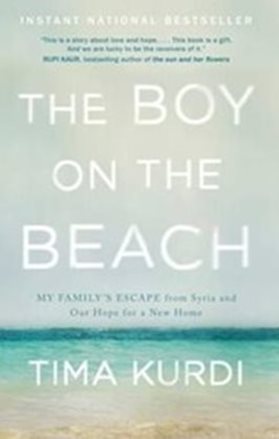
 The Boy on the Beach:
MY FAMILY'S ESCAPE FROM SYRIA AND OUR HOPE FOR A NEW HOME
Author: Rather than introducing readers to refugees as victims, Kurdi presents them first as family members, neighbours, business owners, parents, siblings, and children.
For immigration practitioners, this perspective may be familiar but, over time, can be lost. Legal processes can reduce individuals to categories, such as refugee claimant, permanent resident applicant, overstayer, inadmissible foreign national, and sponsorship applicant. Kurdi's narrative pushes firmly in the opposite direction. Every chapter reveals the individuality and humanity of those who become migrants through circumstances beyond their control.
The memoir serves as an important reminder that migration rarely begins with a desire to leave home. More often, it begins with a desire to stay, followed by a gradual realization that staying is no longer possible.
Many books address the Syrian conflict through geopolitical analysis, military history, or international relations. Kurdi instead examines war through its effects on ordinary families.
The book vividly illustrates how armed conflict destroys not only lives, but also institutions, communities, routines, and expectations about the future. The most powerful passages are often the simplest. She writes:
I had been living in two worlds. In one world, I was a wife and mother and hairdresser living a lovely life in Vancouver, Canada. In the other world, I was helping my family, desperate Syrian refugees who had given up hope of a sustainable life in Istanbul and had turned their sights on Kos [Greece].
In an effort to provide such support as she could, she pressed everyone she engaged with to intervene on behalf of her brother and his family. At the same time, she communicated with him frequently as his circumstances in Syria deteriorated, and then as he and his family ran the gauntlet towards Canada.
The chapters recounting the escape from Syria are especially compelling. Drawing on family recollections and personal involvement, Kurdi recounts the realities of irregular migration.
It was in this way that Kurdi vicariously experienced the refugee ordeal, learning that, at first, family gatherings disappear, then relatives scatter across continents and then entire support networks collapse. Coincidentally, the authorities become decreasingly receptive to increasingly desperate entreaties, as criminals step in to present the only opportunities for relief. Finally, as money disappears, important decision must be made quickly and recklessly, on the basis of limited information and on faith. Lawyers who have represented refugee claimants will recognize many of the experiences described.
The memoir demonstrates that refugee journeys rarely resemble the polarized narratives found in political debate. They are neither stories of effortless migration nor stories of simple victimhood. Instead, they are characterized by risk, uncertainty, resourcefulness, desperation and – occasionally – great kindness.
Particularly effective is Kurdi's exploration of the guilt experienced by family members abroad. Her reflections on helping to finance the fatal crossing reveal a dimension of migration that receives relatively little attention in public discourse.
A recurring theme throughout the book is the tension between symbolic moments and lasting change.
It is undeniable that the image of Alan Kurdi altered public discourse. The photograph generated global attention, increased charitable donations, and intensified debate regarding refugee protection. In Canada, it became a significant issue during the 2015 federal election campaign and contributed to broader discussions concerning refugee resettlement and humanitarian responsibility.
Yet Kurdi repeatedly asks whether the attention generated by the photograph translated into meaningful long-term action. The memoir therefore becomes an examination not only of tragedy, but also of collective memory and political will.
Relevance for Practitioners
This is where the memoir becomes especially valuable for Canadian immigration lawyers.
Most legal practitioners spend considerable time addressing procedural matters such as deadlines, forms, evidentiary requirements, sponsorship undertakings, admissibility concerns, judicial review applications, and tribunal hearings. Such work is an essential expression of our commitment to justice as professionals. Yet it can occasionally obscure the human realities from which these legal processes emerge.
The Kurdi family's story intersects with and breathes life into numerous aspects of Canadian immigration law, including:
- refugee resettlement;
- private sponsorship;
- family reunification;
- humanitarian protection;
- overseas processing;
- barriers to documenting identity and risk;
- security considerations;
- administrative delay; and
- international burden-sharing.
In the circumstances, The Boy on the Beach occupies a distinctive place in Canadian immigration history. Although the events unfolded thousands of kilometres from Canada's shores, Alan Kurdi's death became a defining moment in this country's conversation about refugee protection, private sponsorship, and Canada's humanitarian responsibilities.
In this country the photograph of a deceased toddler, washed up on a beach like flotsam, prompted particularly intense public scrutiny of refugee policies and procedures, as it became public during a federal election campaign. After its release, the Conservative government of Stephen Harper faced criticism for its response to the Syrian refugee crisis, and Liberal leader Justin Trudeau, who ultimately prevailed in the election, adopted a more expansive and humanitarian refugee policy.
The extent to which the child’s death contributed to victory at the polls for Trudeau is, of course, incalculable. However, it is clear that it generated debate about the accessibility and effectiveness of lawful protection pathways and contributed to a broader national discussion about Canada's role in responding to the Syrian refugee crisis.
Thanks to the author’s account of the story, the post-election debate was particularly lively at least in part because it became clear that the child had family members in Canada, and that Canadians’ confidence and pride that we had processes that could respond to needs like his may have been illusory.
For Canadian immigration lawyers, the story therefore resonates on two levels: as a deeply personal account of one family's loss and as a reminder that immigration law operates within a larger social and political context in which individual cases can shape public understanding, influence policy discussions, and ultimately affect the development of refugee protection systems themselves.
The book is particularly illuminating for those involved in sponsorship work. Kurdi's deion of her efforts to secure safe pathways for family members highlights the practical challenges, the mystification, the frustration and the personal costs that applicants and sponsors face when navigating complex systems.
The memoir also inevitably engages with difficult questions about refugee sponsorship and protection. Although it is written from the perspective of a grieving family member rather than a policy analyst, the events she describes unfolded against a backdrop of debate concerning private refugee sponsorship, the operation of the Group of Five sponsorship program, the availability of lawful pathways to protection for Syrian refugees, and the respective roles of host countries, resettlement states, and international protection systems. Her account underscores the practical limitations of refugee protection systems that depend upon complex eligibility requirements, documentary evidence, processing procedures, and finite resettlement spaces within prescribed curbs in a politically charged environment.
Readers may differ on where the responsibility for the circumstances that led the Kurdi family to attempt the crossing from Turkey to Greece ultimately lies. Some will emphasize the challenges facing governments tasked with administering large refugee programs, while others will focus on the barriers encountered by displaced families seeking lawful pathways to safety. One of the memoir's strengths is that, as stated previously, it does not attempt to resolve those debates so much as it humanizes them, reminding readers that abstract policy discussions often have profound consequences for identifiable individuals and families.
Equally important is the book's reminder that legal status does not resolve all refugee challenges. Displacement produces long-term psychological, cultural, familial, and economic consequences that continue well after arrival in a country of refuge, as they did for Tima Kurdi.
The memoir also offers a valuable perspective on public attitudes toward refugees. As immigration lawyers we fare all familiar with the polarized political debates regarding migration. It may be argued that where potential economic contributions to the country are not central to an immigration application, it is evidence of the applicant’s hardships, relationships and personal story that will carry the day more often than legal argument. Kurdi demonstrates how individual stories can go even further: they can reshape public understanding by replacing abstraction with personal experience.
Humanizing a Global Crisis
In the circumstances, the book's principal achievement is its ability to transform an iconic image into a fully realized human story. Indeed, one of Kurdi's stated objectives in writing it was to ensure that readers encounter Alan first as a child and family member rather than as a symbol.
The memoir benefits from Kurdi's position at the centre of events. Her account carries emotional credibility because she does not present herself as a detached observer. Instead, she openly discusses grief, frustration, guilt, helplessness, and hope.
Although the narrative is undeniably heartbreaking, it is not relentlessly bleak. Stories of kindness appear throughout. Neighbours help strangers. Family members support one another across continents. Volunteers assist refugees. Communities rally around newcomers. These moments prevent the book from becoming a catalogue of suffering and reinforce its central message concerning shared humanity.
Kurdi writes for a broad audience rather than a specialist readership. The absence of extensive political or legal analysis makes the book accessible to readers without prior knowledge of Syria, refugee law, or international affairs.
On the other hand, readers seeking a detailed account of the Syrian civil war or of immigration or asylum policy may find portions of the book unsatisfying, as Kurdi's focus is personal rather than geopolitical or legal.
As a result, the book occasionally favours emotional narrative over policy examination and leaves certain competing perspectives unexplored. Whether one regards this as a limitation will largely depend on one's expectations: readers looking for extensive historical or policy analysis will need to consult additional sources.
Similarly, the memoir occasionally adopts an explicitly advocacy-oriented tone. This is understandable given its purpose, but some readers may prefer a more detached and balanced approach to the issues.
There are also moments where complex policy questions are necessarily simplified. Refugee systems, sponsorship programs, and international responses to displacement involve competing legal, political, and practical considerations. The memoir understandably focuses on the human consequences of those systems rather than providing a comprehensive analysis of how they do or could operate.
These observations, however, should be viewed as limitations of genre rather than defects in execution. The author set out to write a memoir, not a policy treatise.
Conclusion
For immigration lawyers, The Boy on the Beach offers something that legal texts cannot. It provides an intimate perspective on the human realities underlying refugee and immigration law. By restoring a human face to concepts that often appear to us only in legislation, jurisprudence, and administrative records, Kurdi invites practitioners to reflect on the values that animate our work and the refugee protection system itself.
The memoir succeeds as a family history, an account of displacement, a tribute to lost loved ones, and a call to conscience.
Ultimately, its central lesson is one that every immigration lawyer already knows, but one which each of us may occasionally need to be reminded: behind every file number is a family, behind every application is a life, and behind every legal proceeding is a human story. In my view, few memoirs convey that truth more effectively than The Boy on the Beach.
Any article or other information or content expressed or made available in this Section is that of the respective author(s) and not of the OBA.